
Beam Shop
Mrs. Raffles: Amateur Crackswoman
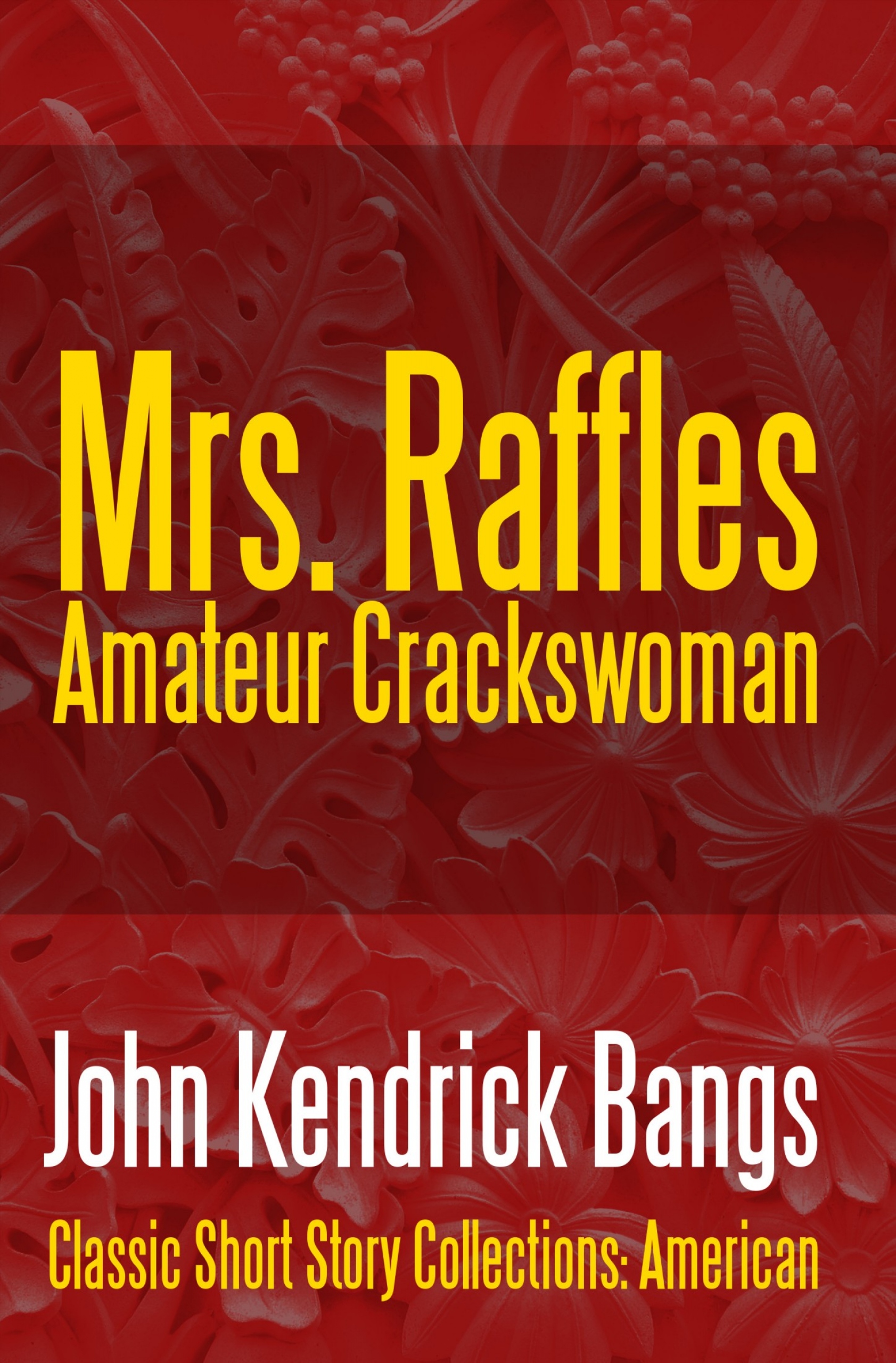
This is one of two short story collections as sequels to the
Raffles
books by E.W. Hornung.
THE ADVENTURE OF THE
HERALD
PERSONAL (excerpt)
That I was in a hard case is best attested by the fact that when I had paid for my Sunday
Herald
there was left in my purse just one tuppence-ha'penny stamp and two copper cents, one dated 1873, the other 1894. The mere incident that at this hour eighteen months later I can recall the dates of these coins should be proof, if any were needed, of the importance of the coppers in my eyes, and therefore of the relative scarcity of funds in my possession. Raffles was dead—killed as you may remember at the battle of Spion Kop—and I, his companion, who had never known want while his deft fingers were able to carry out the plans of that insinuating and marvellous mind of his, was now, in the vernacular of the American, up against it. I had come to the United States, not because I had any liking for that country or its people, who, to tell the truth, are too sharp for an ordinary burglar like myself, but because with the war at an end I had to go somewhere, and English soil was not safely to be trod by one who was required for professional reasons to evade the eagle eye of Scotland Yard until the Statute of Limitations began to have some bearing upon his case. That last affair of Raffles and mine, wherein we had successfully got away with the diamond stomacher of the duchess of Herringdale, was still a live matter in British detective circles, and the very audacity of the crime had definitely fastened the responsibility for it upon our shoulders. Hence it was America for me, where one could be as English as one pleased without being subject to the laws of his Majesty, King Edward VII., of Great Britain and Ireland and sundry other possessions upon which the sun rarely if ever sets. For two years I had led a precarious existence, not finding in the land of silk and money quite as many of those opportunities to add to the sum of my prosperity as the American War Correspondent I had met in the Transvaal led me to expect. Indeed, after six months of successful lecturing on the subject of the Boers before various lyceums in the country, I was reduced to a state of penury which actually drove me to thievery of the pettiest and most vulgar sort. There was little in the way of mean theft that I did not commit. During the coal famine, for instance, every day passing the coal-yards to and fro, I would appropriate a single piece of the precious anthracite until I had come into possession of a scuttleful, and this I would sell to the suffering poor at prices varying from three shillings to two dollars and a half—a precarious living indeed....
John Kendrick Bangs
(May 27, 1862 – January 21, 1922) was an American author, humorist, editor and satirist.
He was born in Yonkers, New York. His father Francis Nehemiah Bangs was a lawyer in New York City, as was his brother, Francis S. Bangs.[1]
He went to Columbia College from 1880 to 1883 where he became editor of Columbia's literary magazine, Acta Columbia, and contributed short anonymous pieces to humor magazines. After graduation in 1883 with a Bachelor of Philosophy degree in Political Science, Bangs entered Columbia Law School but left in 1884 to become Associate Editor of Life under Edward S. Martin. Bangs contributed many articles and poems to the magazine between 1884 and 1888. During this period, Bangs published his first books.
In 1888 Bangs left Life to work at Harper's Magazine, Harper's Bazaar and Harper's Young People, though he continued to contribute to Life. From 1889 to 1900 he held the title of Editor of the Departments of Humor for all three Harper's magazines and from 1899 to 1901 served as active editor of Harper's Weekly. Bangs also served for a short time (January–June 1889) as the first editor of Munsey's Magazine and became editor of the American edition of the Harper-owned Literature from January to November 1899.
Versandkostenfreie Lieferung! (eBook-Download)
Als Sofort-Download verfügbar
- Artikel-Nr.: SW9781387089222450914
Bewerten
Ein Blick ins Buch
- Artikelnummer SW9781387089222450914
-
Autor
John Kendrick Bangs
- Verlag Midwest Journal Press NPD
- Seitenzahl 84
- Barrierefreiheit
- Keine Angabe: Keine Informationen zur Barrierefreiheit bereitgestellt
- ISBN 9781387089222
- Verlag Midwest Journal Press NPD