
Beam Shop
Latin Commentaries on Revelation
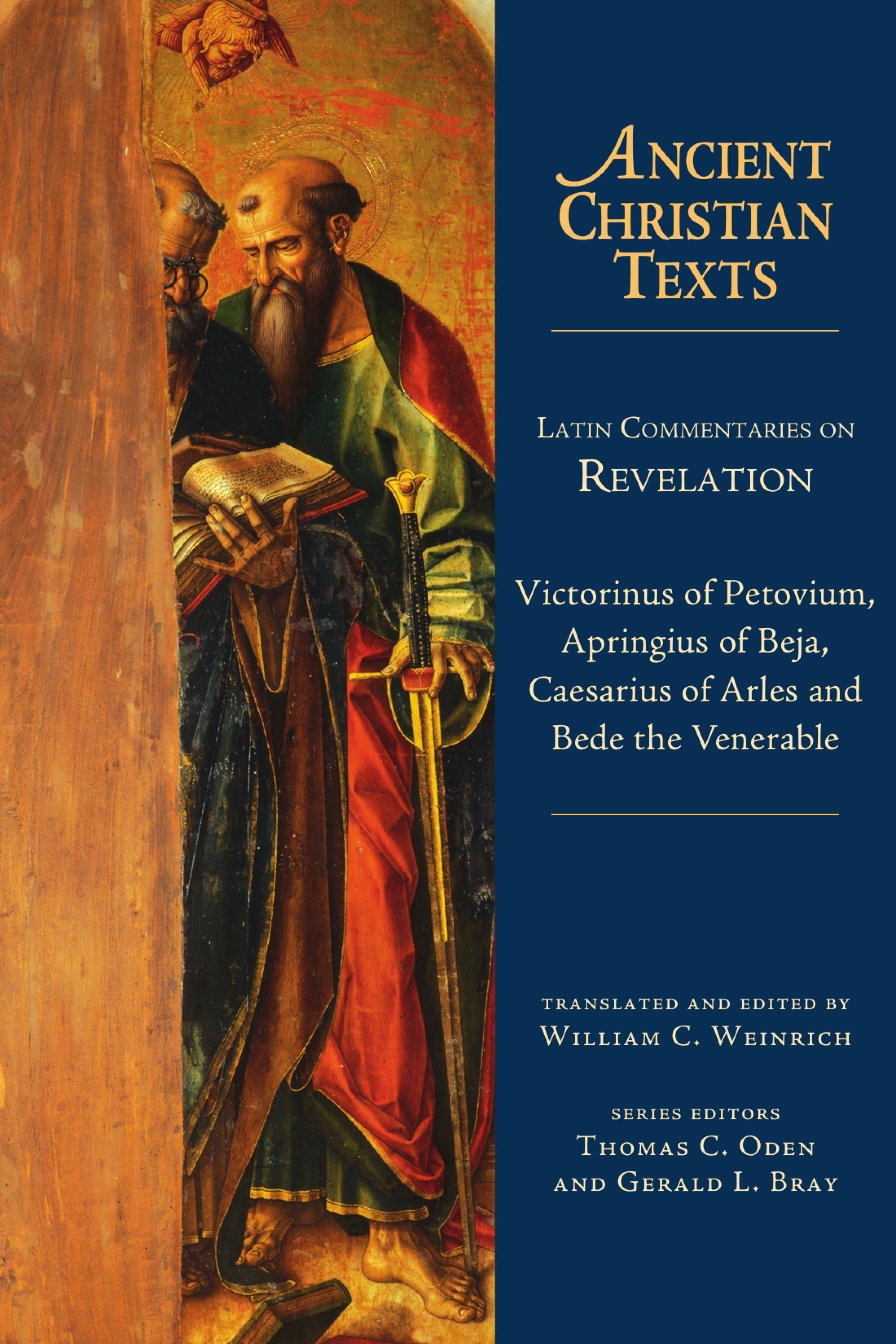
Interest in the book of Revelation in the Western tradition is stronger and earlier than that in the East. The earliest full commentary on the Apocalypse is that of Victorinus of Petovium written in the mid to late third century by the earliest exegete to write in Latin. Victorinus interpreted Revelation in millennialist terms, a mode of interpretation already evident in works by Irenaeus, as well as in modest allegorical terms.
Caesarius of Arles wrote in the early sixth century and offered a thoroughgoing allegorical-ecclesial interpretation of the Apocalypse. Apringius of Beja in Portugal, writing in the mid sixth century, drew on Jerome's edition of Victorinus's commentary yet understood the seven seals christologically as theincarnation, birth, passion, death, resurrection, glory and kingdom.
Bede the Venerable, who died in 735, is the last commentator to be included in this collection. Characteristically, he passes on commentary from earlier exegetes, here including that of Augustine, Gregory the Great, Victorinus, Tyconius and Primasius.
William Weinrich renders a particular service to readers interested in ancient commentary on the Apocalypse by drawing together these significant Latin commentaries. The work of translating these texts was begun in preparing the volume on Revelation in the Ancient Christian Commentary on Scripture. We are indebted to William Weinrich for completing this work with his able and fresh translation and notes on these texts.
Ancient Christian Texts are new English translations of full-length commentaries or sermon series from ancient Christian authors that allow you to study key writings of the early church fathers in a fresh way.
Gerald L. Bray (PhD, La Sorbonne) is a professor at Beeson Divinity School of Samford University in Birmingham, Alabama, and director of research for the Latimer Trust. He has written and edited a number of books on different theological subjects,including Galatians, Ephesians in the Reformation Commentary on Scripture series, Biblical Interpretation: Past and Present, The Doctrine of God, and Romans in the Ancient Christian Commentary on Scripture series. A priestof the Church of England, Bray has also edited the post-Reformation Anglican canons.
William C. Weinrich (DTheol, Basel) is rector of the Luther Academy, theological seminary of the Evangelical Lutheran Church of Latvia. Additionally, he is a professor of early church history and patristic studies at Concordia Theological Seminaryin Fort Wayne, Indiana. He is the author of Spirit and Martyrdom: A Study of the Work of the Holy Spirit in Contexts of Persecution and Martyrdom in the New Testament and Early Christian Literature and editor of The New Testament Age: Essays in Honor of Bo Reicke.
Thomas C. Oden (1931–2016), was the general editor of the Ancient Christian Commentary on Scripture and the Ancient Christian Doctrine series as well as the author of Classic Christianity, a revision of his three-volume systematic theology. His books also include The African Memory of Mark, Early Libyan Christianity, and How Africa Shaped the Christian Mind. He was the director of the Center for Early African Christianity at Eastern University in Pennsylvania and he also served as the Henry Anson Buttz Professor of Theology at the Graduate School and The Theological School of Drew University in Madison, New Jersey.
General Introduction
Abbreviations
Translator?s Introduction
Victorinus of Petovium
Commentary on the Apocalypse
Chapter One
Chapter Two
Chapter Three
Chapter Four
Chapter Five
Chapter Six
Chapter Seven
Chapter Eight
Chapter Nine
Chapter Ten
Chapter Eleven
Chapter Twelve
Chapters Thirteen and Seventeen
Chapter Fourteen and Seventeen
Chapter Nineteen
Chapter Twenty
Chapter Twenty-one
Apringius of Beja
Explanation of the Revelation by the Most Learned Man, Apringius, Bishop of Pax [Julia]
Chapter One
Chapter Two
Chapter Three
Chapter Four
Chapter Five
Chapter Eigheen
Chapter Nineteen
Chapter Twenty
Chapter Twenty-one
Chapter Twenty-two
Caesarius of Arles
Exposition on the Apocalypse
Exposition on the Revelation of Saint John
The Continuation of the Exposition of the Revelation (Homily2)
Again, a Continuation of the Revelation (Homily 3)
A Continuation of the Revelation (Homily 4)
The Continuation (Homily 5)
The Continuation (Homily 6)
The Continuation (Homily 7)
The Continuation (Homily 8)
TheContinuation (Homily 9)
The Continuation (Homily 10)
The Continuation (Homily 11)
The Continuation (Homily 12)
The Continuation (Homily 13)
The Continuation (Homily 14)
The Continuation (Homily 15)
The Continuation(Homily 16)
The Continuation (Homily 17)
The Continuation (Homily 18)
The Continuation (Homily 19)
Bede the Venerable
The Exposition of the Apocalypse by Bede the Presbyter
A Versicle of Bede the Elder
Prefatory Letter to Eusebius
Book One
Book Two
Book Three
Scripture Index
"This is an excellent contribution to a much-needed series, which, along with Weinrich's companion volume on the Greek commentaries of Oecumenius and Andreas of Caesarea, makes available to a wider readership the diversity and rich sophistication of early exegesis of Revelation. Revelation scholars will profit immensely from the interpretive possibilities explored by their ancient predecessors."
Versandkostenfreie Lieferung! (eBook-Download)
Als Sofort-Download verfügbar
- Artikel-Nr.: SW9781514015216110164
Bewerten
Ein Blick ins Buch
- Artikelnummer SW9781514015216110164
-
Autor
Victorinus of Petovium, Apringius of Beja, Caesarius of Arles, Bede the Venerable
- Mit William C. Weinrich, Thomas C. Oden, Gerald L. Bray
- Wasserzeichen ja
- Verlag IVP Academic
- Seitenzahl 201
- Barrierefreiheit
- ISBN 9781514015216
- Mit William C. Weinrich, Thomas C. Oden, Gerald L. Bray