
Beam Shop
Sacred Enigmas of the Americas
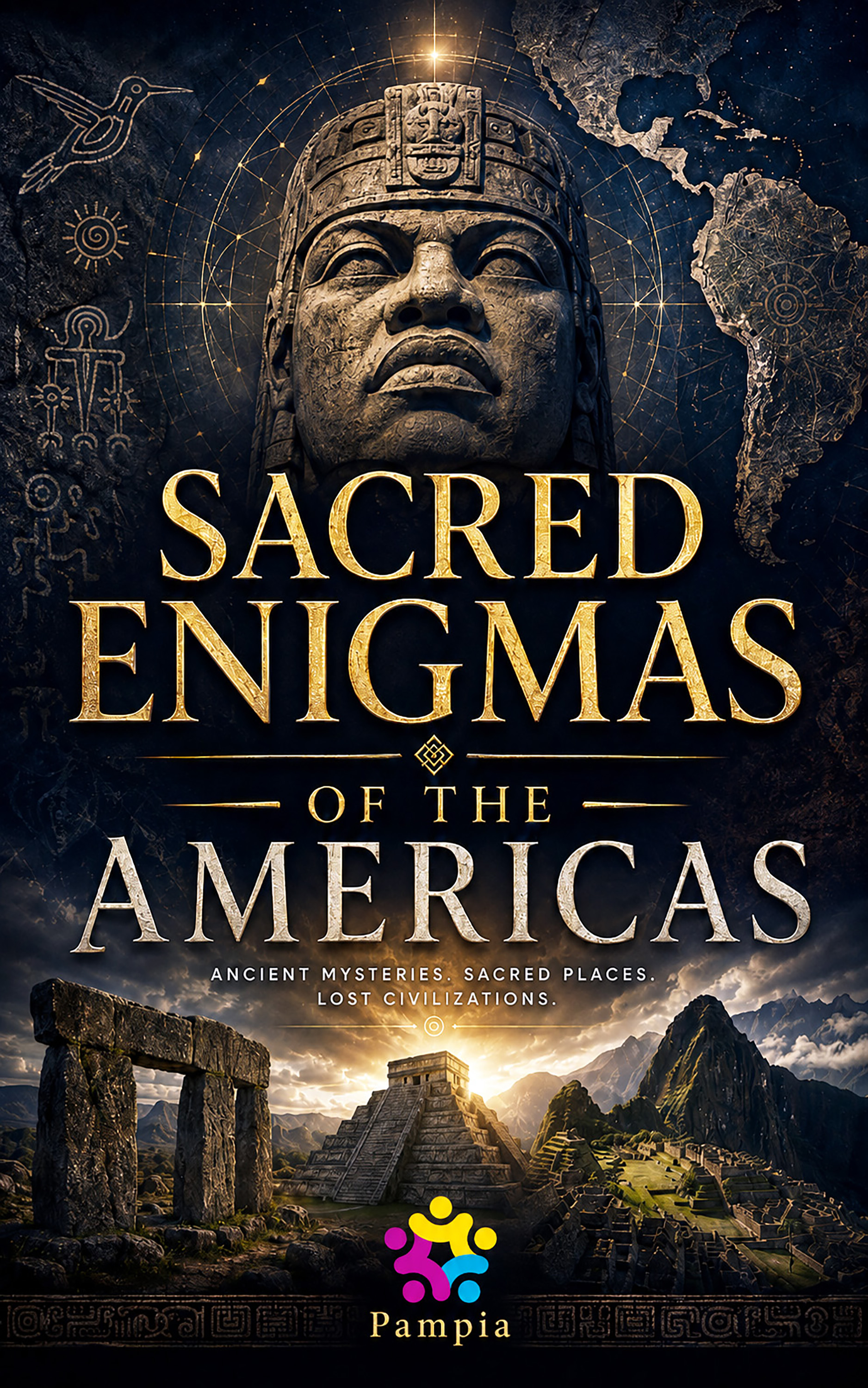
Why did the Maya build splendid cities in the jungle and then walk away from them? How did a people without metal tools carve a skull from a single block of quartz? And who, exactly, is the figure reclining on the lid of Pakal's sarcophagus at Palenque?
Sacred Enigmas of the Americas travels the continent from the Bering land bridge to the shores of Rapa Nui in search of the questions archaeology has not closed. Michel Marcel-Levy does not sell answers: he lays out the evidence, weighs the hypotheses — the cautious and the daring alike — and lets the reader decide where the ground gives way.
The journey begins with the peopling of the Americas and with the travelers who may have arrived long before 1492: Vikings, an Irish monk, a Welsh prince, an emperor of Mali who sailed west and never returned. It moves on to the Maya — Tikal, Copan, Chichen Itza, Uxmal, Palenque — and to the abandonment that no theory fully explains. It descends into the cenotes and caves of Yucatan, the passages the Maya believed led to the underworld, and it reads the seven prophecies drawn from the Chilam Balam, the book that turned 2012 into a household date long before the internet did.
At the heart of the book lies Pakal the Great and the sarcophagus lid that some read as a Maya cosmogram and others as an astronaut at the controls of a capsule. From there the enigmas multiply: the crystal skulls, and the Mitchell-Hedges skull with its separately carved jaw; the Olmec colossal heads and the Cascajal block, the oldest writing in the Americas; the perfect stone spheres of the Diquis delta, carved from a rock that does not outcrop there.
A long chapter confronts human sacrifice without flinching and without appetite, drawing on the sixteenth-century chroniclers and on the archaeology that has since either confirmed or corrected them: the methods, the ritual calendar of eighteen twenty-day months, and the uncomfortable question of how much the Spanish chroniclers exaggerated.
Then the Andes. Machu Picchu and Hiram Bingham's discovery. The Nazca lines, drawn to be seen from a sky no one could reach. Tiahuanaco at four thousand meters, its Gate of the Sun and its trepanned skulls whose edges healed. And at last Rapa Nui, its moai, and the rongo-rongo tablets: a script still unread, whose alternate lines run in reverse.
Thirty-five original illustrations, drawn for this edition, accompany the text: maps, site plans, cross-sections and codex-style plates.
First published in Spanish in 2008 and now available in English for the first time, this is a book for readers who prefer a well-posed question to a comfortable answer.
Michel Marcel was born in Toulouse, France, in 1956. A man of wide-ranging intellectual interests and an insatiable curiosity about the human past, he drew equally on journalism —publishing travel chronicles and investigative features in various European outlets— and on the rigorous study of history, archaeology, comparative religion, and anthropology.
His fascination with the enigmas of pre-Columbian civilizations led him to leave Europe for a series of field expeditions that marked a turning point in both his life and his work. That immersion took him to Cuzco, Peru, where he lived for two years, and to Oaxaca, Mexico, for five more, sharing daily life with local communities and studying the archaeological remains of the Andes and Mesoamerica firsthand. He now lives in Paris once again, where he coordinates his research and publishing projects.
His first book, Sacred Enigmas of America, established his voice as a writer capable of fusing documentary rigor with historical mystery. Far from resting on the success of his debut, Marcel is currently preparing his second book, an ambitious work of investigation that will delve into the complex and somber subject of human sacrifice throughout history and within the world's diverse civilizations.
Sacred Enigmas of the Americas gathers the archaeological questions the continent has not answered. From the peopling of the Americas across Beringia to the moai of Rapa Nui, Michel Marcel-Levy examines the cities the Maya abandoned without explanation, the cenotes they held to be doorways into the underworld, and the seven prophecies that made 2012 famous. He devotes his central chapters to Pakal the Great and the sarcophagus lid of Palenque, read by some as a cosmogram of the Maya underworld and by others as an astronaut at the controls; to the crystal skulls; to the Olmec colossal heads and the Cascajal block; and to the granite spheres of the Diquis delta, whose stone does not occur where they were found. The Andes bring Machu Picchu, the Nazca lines and Tiahuanaco with its healed trepanations. The author sets out the evidence, weighs the cautious hypotheses against the daring ones, and leaves the verdict to the reader. Thirty-five original illustrations were drawn for this edition.
From Beringia to Rapa Nui: the questions American archaeology has never closed.
Versandkostenfreie Lieferung! (eBook-Download)
Als Sofort-Download verfügbar
- Artikel-Nr.: SW9786316559777110164
Bewerten
Ein Blick ins Buch
- Artikelnummer SW9786316559777110164
-
Autor
Michel Marcel-Levy
- Verlag Pampia Grupo Editor
- Seitenzahl 210
- Barrierefreiheit
- ISBN 9786316559777
- Verlag Pampia Grupo Editor