
Beam Shop
Relationship Anarchy
Occupy Intimacy!
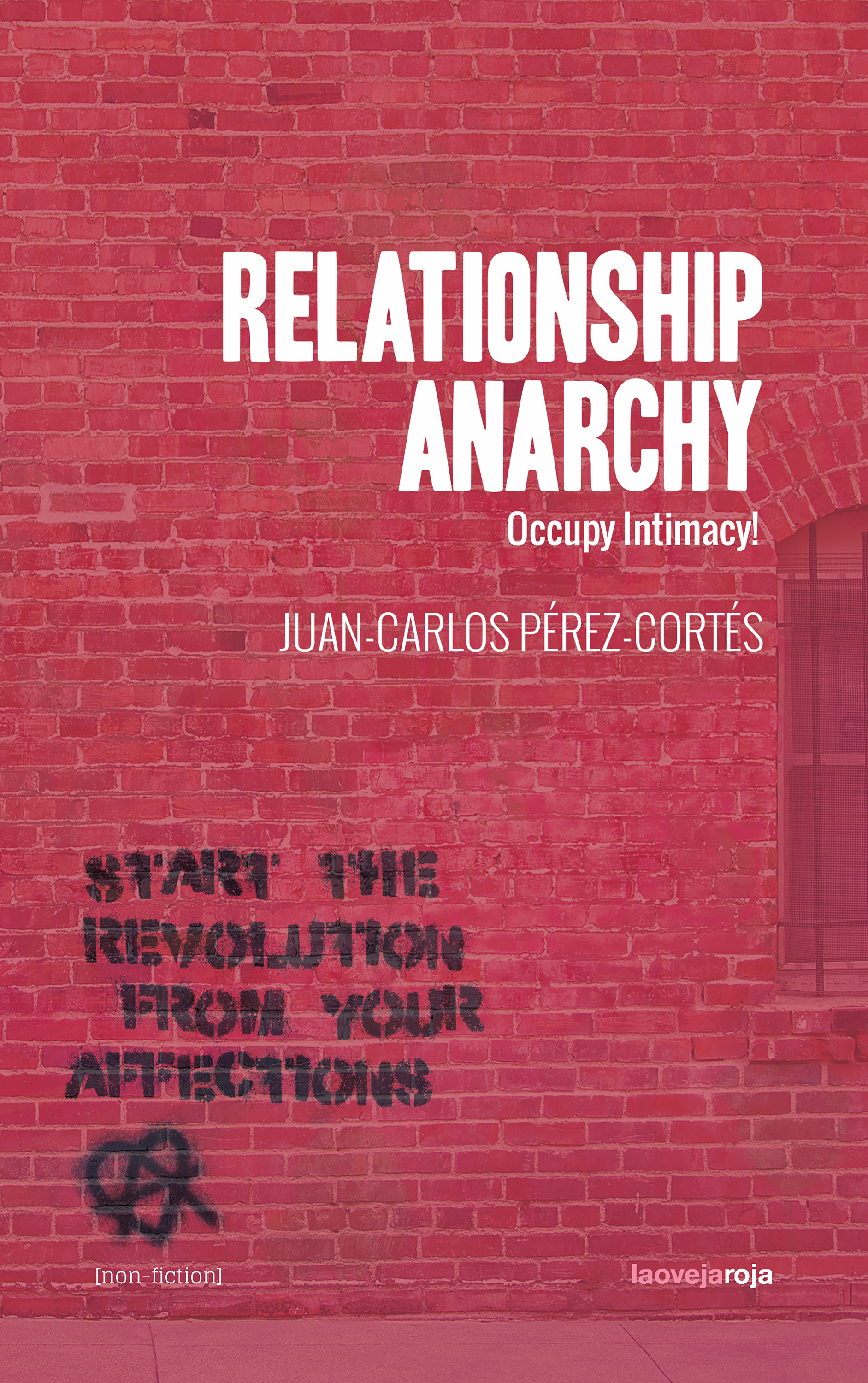
A non-fiction best-seller that intertwines the principles of social anarchism with an extension of politics to interpersonal relationships.
This «relationship anarchy» endeavors to be a real revolution sparked from our affections, rooting not only in the long tradition of anarchism but also in contributions from the most recent sociology, anthropology, feminism, queer theory, and non-monogamous activisms. At a time when revolutionary perspectives seem to have moved beyond the horizon, the challenge of relationship anarchy is to build non-hierarchical networks of mutual care, trying to extend to intimacy the ideals that we would like to lead in society, overcoming normativity, inherited power structures, and stereotyped control mechanisms.
Juan Carlos Pérez-Cortés
SILLA (VALÈNCIA, SPAIN), 1966
Researcher in Artificial Intelligence with extensive scientific production in this field. He is a full professor at the Universitat Politècnica de València, Spain, founder and director of the Perception, Recognition, Learning, and Artificial Intelligence research group. He has been the scientific director of the University Research Institute, where his group has been based for a decade.
Outside his academic field, he has participated in events and spaces related to non-normative relationships since 2010; he was the author of one of the first translations into Spanish of the Relationship Anarchy Manifesto and actively contributes to its dissemination in different spaces of debate. He is co-founder of the Association for Affective, Ethical, Non-normative Relationships of Valencia, which organizes, among other activities, one of the most attended relational activism meetings in Europe, the OpenCon Valencia, which in 2023 will reach its third edition. It has participated in the first Meeting on Relational Anarchy in Spain, other national and international meetings, and workshops and conferences on relationships and normativity.
Foreword
Introduction to the English Edition
Preface
Introduction
Chapter 1. What is Relationship Anarchy?
1.1 The political becomes personal
1.2 Where and when did all this come about?
1.3 Who's taken an interest in relationship anarchy so far?
1.4 Perspectives, interpretations, and critical views
1.5 What is relationship anarchy not?
Chapter 2. Cultural and historical perspective
2.1 Authority, family, private property, and anarchism
2.2 Feminism and anarcho-feminism
2.3 Relationship anarchy and anarchism
2.4 Free love, polyamory, ethical non-monogamies, and affective networks
2.5 Biological and anthropological perspective
Chapter 3. I relate to others in a different way: labels, models, and practices
3.1 Labels and models
3.2 The relationship escalator
3.3 Queer theory
3.4 Axes of a multidimensional relational space
3.5 From amorous thought to non-normative practices
Chapter 4. The revolution that starts with bonds: ethical, collective keys
4.1 Privileges and resistance practices
4.2 Identities and sensibilities
4.3 Freedom, rights, entitlement, and agreements
4.4 Family of origin, chosen family, and raising children
4.5 Models of life, cohabitation, and care
Chapter 5. A way of sharing based on commitments and boundaries: relational keys
5.1 Touching down
5.2 Critical deconstruction of the ideology of the couple
5.3 Difficulties, obstacles, and collective ways of overcoming
5.4 Sustainable relationships
Chapter 6. Making what's nameless visible: relationship activism
6.1 What activism, and why?
6.2 Support networks and civil and economic rights
6.3 Collectives, spaces of socialization, and actions for visibility
6.4 The future
Epilogue
Glossary
Versandkostenfreie Lieferung! (eBook-Download)
Als Sofort-Download verfügbar
- Artikel-Nr.: SW9788416227587110164
Bewerten
Ein Blick ins Buch
- Artikelnummer SW9788416227587110164
-
Autor
Juan-Carlos Pérez-Cortés
- Wasserzeichen ja
- Verlag La Oveja Roja
- Seitenzahl 400
- Barrierefreiheit
- ISBN 9788416227587
- Wasserzeichen ja