
Beam Shop
Task-based grammar teaching of English
Where cognitive grammar and task-based language teaching meet
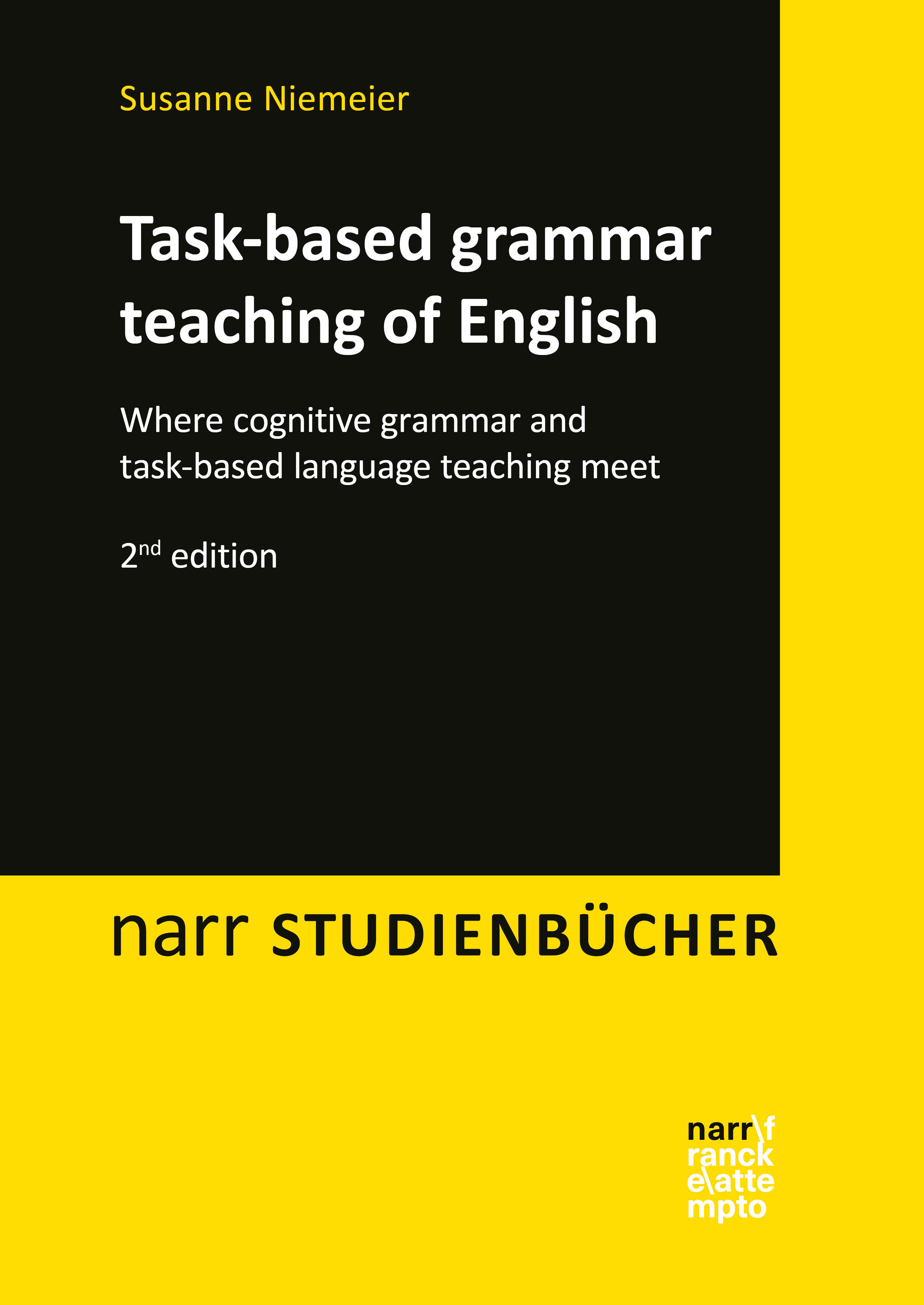
The focus on communication in TBLT often comes at the expense of form. This book enhances the task-based approach by connecting it to insights from (cognitive) grammar, which sees grammar as meaningful. It shows how grammar teaching can be integrated into a communicative lesson in a non-explicit way. Learners are involved in situations that they may also encounter outside their classrooms and are given communicative tasks they are to work on and solve. What teachers need to invest for preparing such lessons is their own creativity, as they have to come up with meaningful communicative situations which guide the learners into using a specific structure. The book discusses the didactic and linguistic theories involved and translates the theoretical perspectives into actual teaching practice, focusing on the grammatical phenomena tense (present tense, past tense, present perfect), aspect, modality, reported speech, conditionals, passive voice, prepositions, phrasal verbs, verb complementation, pronouns and articles.
Susanne Niemeier (*1960) studied English and French and received her PhD in linguistics in 1990 (supervisor Prof. Dr. René Dirven). In 2002, she was appointed as professor of Applied Linguistics and Foreign Language Teaching Methodology in the English Department of the University of Koblenz (Germany). Her main research interests include cognitive grammar, cultural linguistics, bilingualism, foreign language education and teacher education. She has published widely on these topics. From 2012 until 2014, she was elected as head of the German Cognitive Linguistics Association, and she has held positions on the executive boards of AILA (Association Internationale de Linguistique Appliquée) and GAL (German Applied Linguistics Association) as well as on various editorial boards.
0.Introduction
PART I: Didactic and linguistic theory
1.Grammar in the foreign language classroom
1.1Current situation
1.2A brief history of grammar teaching
2.Task-based language teaching
2.1 The development of task-based language teaching
2.2 The task cycle
2.2.1 Pre-task
2.2.2 Task
2.2.3 Language focus
2.3 The role of grammar in task-based language teaching
3.Cognitive grammar
3.1 The development of cognitive linguistics
3.1.1 Embodiment
3.1.2 Lexis-grammar continuum
3.1.3 Categorization
3.1.4 Usage-based perspective
3.1.5 Perspective on language acquisition
3.2 The cognitive grammar perspective on language
3.2.1 The centrality of meaning
3.2.2 Construal
3.3 Pedagogical applications of cognitive grammar
3.3.1 Advantages of applied cognitive grammar
3.3.2 Research on applied cognitive grammar
4.Cognitive grammar and task-based language teaching
PART II: Case Studies
5.Tense
5.1 A cognitive grammar perspective on tense
5.2 The present tense
5.2.1 Form
5.2.2 Meaning
5.2.3 Communicative situation and didactic reduction
5.2.4 The task cycle
5.2.5 Alternatives
5.3 The past tense
5.3.1 Form
5.3.2 Meaning
5.3.3 Communicative situation and didactic reduction
5.3.4 The task cycle
5.3.5 Alternatives
5.4 The present perfect
5.4.1 Form
5.4.2 Meaning
5.4.3 Communicative situation and didactic reduction
5.4.4 The task cycle
5.4.5 Alternatives
6.Aspect
6.1 Form
6.2 Meaning
6.2.1 Lexical aspect
6.2.2 Grammatical aspect
6.2.3 Non-prototypical uses of aspect
6.3 Communicative situation and didactic reduction
6.4 The task cycle
6.5 Alternatives
7.Modality
7.1 Form
7.2 Meaning
7.2.1 Root modality
7.2.2 Epistemic modality
7.3 Communicative situation and didactic reduction
7.4 Alternatives
8. Reported speech
8.1 Form
8.2 Meaning
8.2.1 Deixis
8.2.2 Temporal shifts
8.3 Communicative situation and didactic reduction
8.4 The task cycle
8.5 Alternatives
9. Conditionals
9.1 Form
9.2 Meaning
9.2.1 Mental Space Theory
9.2.2 Potentiality space
9.3 Communicative situation and didactic reduction
9.4 The task cycle
9.5Alternatives
10.The passive voice
10.1 Form
10.2 Meaning
10.2.1 Highlighting function
10.2.2 Research results
10.3 Communicative situation and didactic reduction
10.3 The task cycle
10.5Alternatives
11.Prepositions
11.1 Form
11.2 Meaning
11.2.1 Metaphorization
11.2.2 Proto-scenes
11.3 Communicative situation and didactic reduction
11.4 The task cycle
11.5 Alternatives
12.Phrasal verbs
12.1 Form
12.2 Meaning
12.2.1 Semantic networks of the particles
12.2.2 Analyses of the particles up, down, out and in
12.3 Communicative situation and didactic reduction
12.4 The task cycle
12.5 Alternatives
13.Verb complementation
13.1 Form
13.2 Meaning
13.2.1 Iconicity
13.2.2 The complementizers
13.3 Communicative situation and didactic reduction
13.4 The task cycle
13.5 Alternatives
14.Pronouns
14.1 Form
14.2 A cognitive-linguistic perspective on pronouns
14.3 Personal pronouns
14.3.1 Meaning
14.3.2 Communicative situation and didactic reduction
14.3.3 The task cycle
14.3.4 Alternatives
14.4 Possessive pronouns
14.4.1 Meaning
14.4.2 Communicative situation and didactic reduction
14.4.3 The task cycle
14.4.4 Alternatives
15.Articles
15.1 Form
15.2 Meaning
15.2.1 Definiteness vs. indefiniteness
15.2.2 Boundedness vs. unboundedness
15.3 Communicative situation and didactic reduction
15.4 The task cycle
15.5 Alternatives
16. Conclusion
Versandkostenfreie Lieferung! (eBook-Download)
Vorbestellerartikel: Dieser Artikel erscheint am 27. April 2026
- Artikel-Nr.: SW9783381109623110164
Bewerten
Ein Blick ins Buch
- Artikelnummer SW9783381109623110164
-
Verlag
Narr Francke Attempto Verlag
- Veröffentlichung 27.04.2026
- ISBN 9783381109623
- Veröffentlichung 27.04.2026